

Düsseldorf Airport (GER)
Background
Besides being the leading international air travel hub in the German state of North Rhine-Westphalia, Düsseldorf Airport is also one of the country’s largest airports, welcoming more than 20 million passengers in 2025.1 Its annual electricity consumption is comparable to that of a small town.
The airport gets most of the power it needs from the city’s municipal utilities. This is TÜV-certified green electricity, all of which comes from renewable energy sources such as solar, wind, and hydropower. To further reduce emission intensity, the airport also operates its own photovoltaic systems and relies on highly efficient combined heat and power (CHP) technology. The emphasis is on highly efficient CHP, because the airport’s climate action strategy focuses on reducing not only its energy consumption but also its use of raw materials.2
Solution
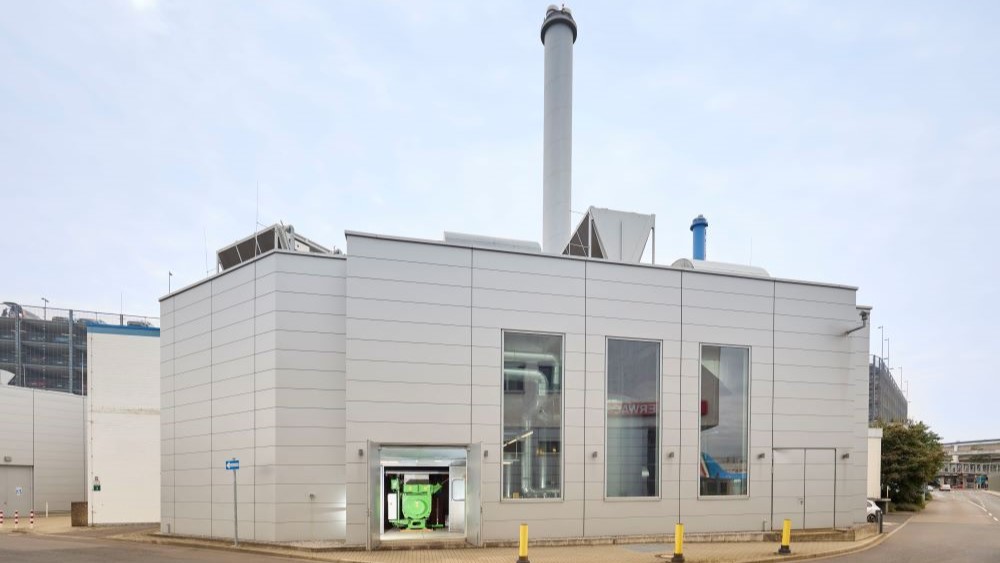
Two Jenbacher CHP units from INNIO Group have been supplying Düsseldorf Airport with a total output of approximately 2 megawatts of electricity since 2013. Both are operated by the subsidiary Flughafen Düsseldorf Energie GmbH. Running at about 75 percent capacity – a level that suits the airport’s requirements – the Jenbacher CHP units cover roughly 12 percent of the airport’s electricity demand, according to the operator. The on-site photovoltaic systems are intended to cover most of the electricity demand, while the Jenbacher CHP units provide reliable support within a balanced energy mix of purchased green electricity and on-site generation.
In addition to electricity, the plant also produces 10,000 MWh of heat annually. During the winter, this
is mainly used to heat the airport building. However, there is also significant demand for heat in the summer months, such as for heating water in food service areas and for the airport’s sanitary facilities. Overall,
the Jenbacher CHP units supply around one-third of the required heat, while the use of an absorption chiller allows thermal energy to also be used for cooling airport buildings in the summer.
Outcome
Not only does Düsseldorf Airport consume as much energy as a small town – its infrastructure is similarly complex. To diversify its power supply, the airport also generates its own electricity to complement what it draws from the public grid. While the output of the onsite photovoltaic systems depends on solar irradiation levels, the two natural-gas-fueled Jenbacher CHP units help secure baseload supply at the airport.
Both units were refurbished in 2022, receiving an update to the Jenbacher control technology and additional sensors for improved monitoring. The plant is therefore even better prepared for future operational requirements.
Customer benefits
- Reliable baseload supply of electricity and heat to
complement intermittent renewable energy sources - The balanced energy mix helps stabilize energy supply
for the airport’s critical infrastructure while supporting
its significant electricity demand. - Highly efficient Jenbacher CHP and control technology
- Many years of operational experience
Location
Installed engines
Electrical output
Thermal output
Energy source
Commissioned